[A VS B] ましょう vs ませんか, Let’s Do It or Would You Like to Join?
Learn how to form mashou and masen ka and choose between suggesting a shared action and asking whether someone would like to join.
JAPANESE · BEGINNER
You want to take a break with a colleague. “Let’s take a break” proposes a shared next step. “Would you like to take a break?” gives the listener a more explicit opening to accept or decline. Both are ways to invite your colleague to join you.
Japanese also has polite ways to invite someone to do something together. Two common forms, ましょう and ませんか, often make a similar distinction in viewpoint. Both can be natural in the same situation.
In this guide
The quick difference
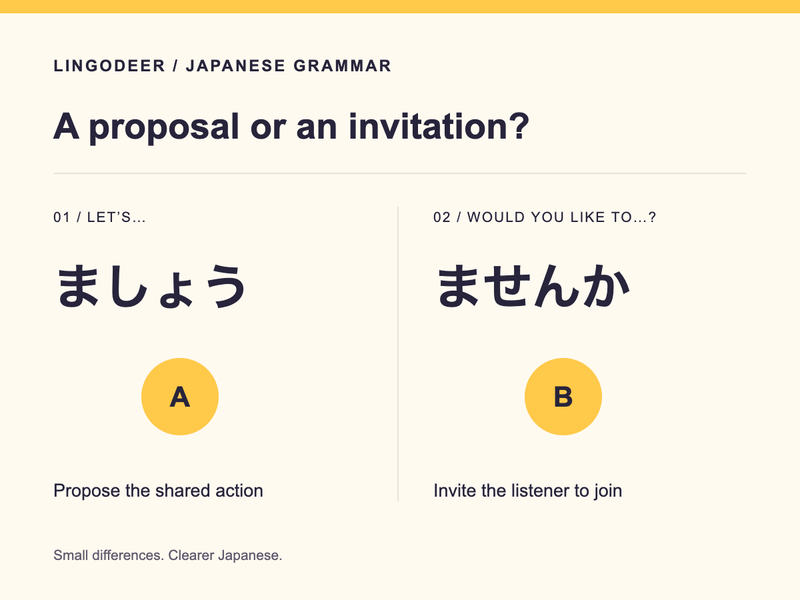
ましょう
Let’s…ませんか
Would you like to…?ましょう presents the speaker’s wish as a proposal for a shared action.
ませんか invites the listener by asking whether they are willing to join the proposed activity.
To form either expression, start with the ます form and replace ます with ましょう or ませんか. For example, 休みます becomes 休みましょう or 休みませんか.
Both forms can sound friendly in a cooperative setting. A supervisor repeating an invitation may make it harder to decline, even with ませんか.
See it in context
01Suggest a break: Two colleagues have been working for a while. Examples 1 and 2 both invite the colleague to take a break together; the viewpoint differs.
Example 1
少し休みましょう。
Let’s take a short break.
Example 2
少し休みませんか。
Would you like to take a short break?
02An invitation and a reply: One friend invites another to go to the botanical garden this weekend. The other accepts.
Whether the invitation uses ませんか or ましょう, you can accept with はい (“Yes”) or いいですね (“Sounds good”). You can also reply with ましょう to confirm that you will do the activity together.
Example 3
週末、植物園に行きませんか。
Would you like to go to the botanical garden this weekend?
Example 4
いいですね。いっしょに行きましょう。
Sounds good. Let’s go together.
03Get a group started: Everyone is gathered for an activity. The organizer suggests starting.
Example 5
そろそろ始めましょう。
Let’s get started.
Example 6
そろそろ始めませんか。
Shall we get started?
Try it yourself
Answer key and explanations
- お茶を飲みましょう。 — 飲みましょう presents a shared suggestion. 飲みませんか asks whether the listener would like to have tea.
- いっしょに散歩しませんか。 — しませんか asks whether your friend would like to join. しましょう suggests walking together more directly.
- いいですね。見ましょう。 — いいですね。見ましょう。 accepts the invitation to watch a movie together. The other reply explains that you are busy that weekend.
- You make a softer invitation, giving your colleague more room to accept or decline. — The shared activity stays the same. ましょう puts forward the speaker’s plan to take a break together; ませんか asks about the colleague’s willingness to join. This shift in viewpoint usually makes the invitation sound softer here.
What to remember
- Both forms can invite someone to do something together. ましょう presents the speaker’s proposal; ませんか asks about the listener’s willingness to join.
- Start with the ます form and replace ます with ましょう or ませんか.
- Accept either invitation with はい or いいですね. A reply with ましょう can confirm the shared plan.
- Both forms can be natural in the same situation. ませんか usually sounds softer, while tone and relationships also shape the invitation.