Spaced Repetition for Language Learning: How SRS Works
Learn how spaced repetition helps you remember vocabulary, why it works, and how to use LingoDeer’s SRS to review what you’ve learned.
Learning a new language means encountering hundreds, if not thousands, of unfamiliar words, expressions, and grammatical structures. But learning something once doesn't necessarily mean you'll remember it a week later.
Have you ever understood a word when you first studied it, only to forget its meaning when you encountered it again the following week?
That's where spaced repetition comes in.
Rather than repeatedly reviewing everything in one sitting, this learning technique spaces reviews out over time, giving you opportunities to recall information before it becomes too difficult to remember. Combined with active recall, it can make vocabulary practice more effective and support long-term retention.
Here's how a Spaced Repetition System (SRS) works, why it helps, and how to use LingoDeer's built-in SRS in your study routine.
What Is a Spaced Repetition System (SRS), and How Does It Help with Language Learning?
A Spaced Repetition System (SRS) is a learning method that schedules reviews at planned intervals. Instead of studying the same material repeatedly in one sitting, you revisit previously learned information over time.
The idea is relatively simple: information that isn't revisited can become harder to recall. By returning to it at different intervals, you give yourself repeated opportunities to retrieve and reinforce what you've learned.
Two important concepts work together in this process:
Spaced practice refers to distributing learning sessions over time rather than concentrating them into one long session. For example, you might review a new Japanese word today, revisit it a few days later, and practice it again the following week.
Active recall means actively retrieving information from memory instead of simply reading or recognizing the answer. When reviewing a flashcard, for instance, you try to remember the meaning of a word before revealing its translation.
These techniques complement each other. Spaced practice determines when you revisit information, while active recall gives you practice retrieving it from memory.
The Spacing Effect: Why Reviewing Over Time Matters
The spacing effect describes a well-documented finding in memory research: information is generally retained better when learning sessions are distributed over time rather than concentrated into a single session.
One important study is a 2006 meta-analysis, published in Psychological Bulletin, with findings showing that the time between study sessions and the length of time before a final test both influence how well information is retained. In general, the optimal spacing between reviews depends partly on how long you want to retain the information.
This is particularly relevant to language learning. Reviewing vocabulary immediately after learning it can help with short-term familiarity, but returning to it after a longer interval provides another opportunity to strengthen long-term recall.
In a 2022 review published in Language Learning, Kim and Webb found that spacing out practice helped people learn a second language. Longer gaps between reviews helped people remember more when tested later. Both fixed intervals and gradually increasing gaps between reviews could work.
The findings suggest that spreading out your practice can help you remember what you've learned long after the lesson ends.
What makes LingoDeer's SRS different?
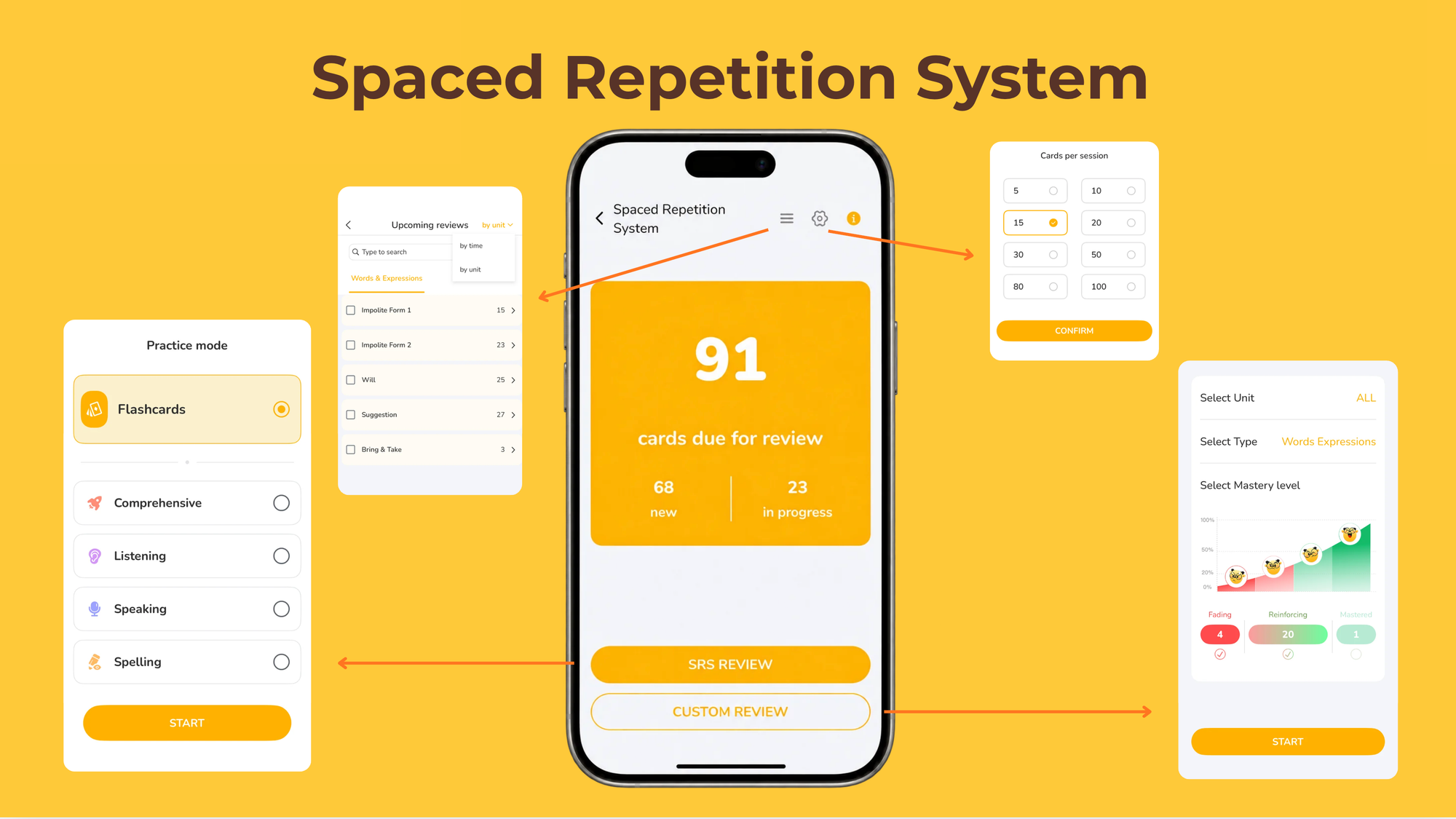
LingoDeer's SRS brings course material, automatically scheduled reviews, and five practice modes together in the Review section. You can revisit what you've learned without having to organize every review session yourself.
Here's how these features make it easier to keep reviewing as you progress through your course.
Course Material with Automatically Scheduled Reviews
Once you complete the relevant lessons in the main course, the material you've learned is automatically added to your SRS. You can go straight from learning to reviewing without creating your own flashcards or transferring vocabulary to another app.
Your review schedule is automatically updated based on several factors, including your performance in previous SRS sessions, the current mastery level of each item, and the time since you last reviewed it.
This means different items can have different review schedules. Material that needs more reinforcement can return sooner, while more familiar items can be scheduled for later reviews.
Three Mastery Levels to Track Your Progress
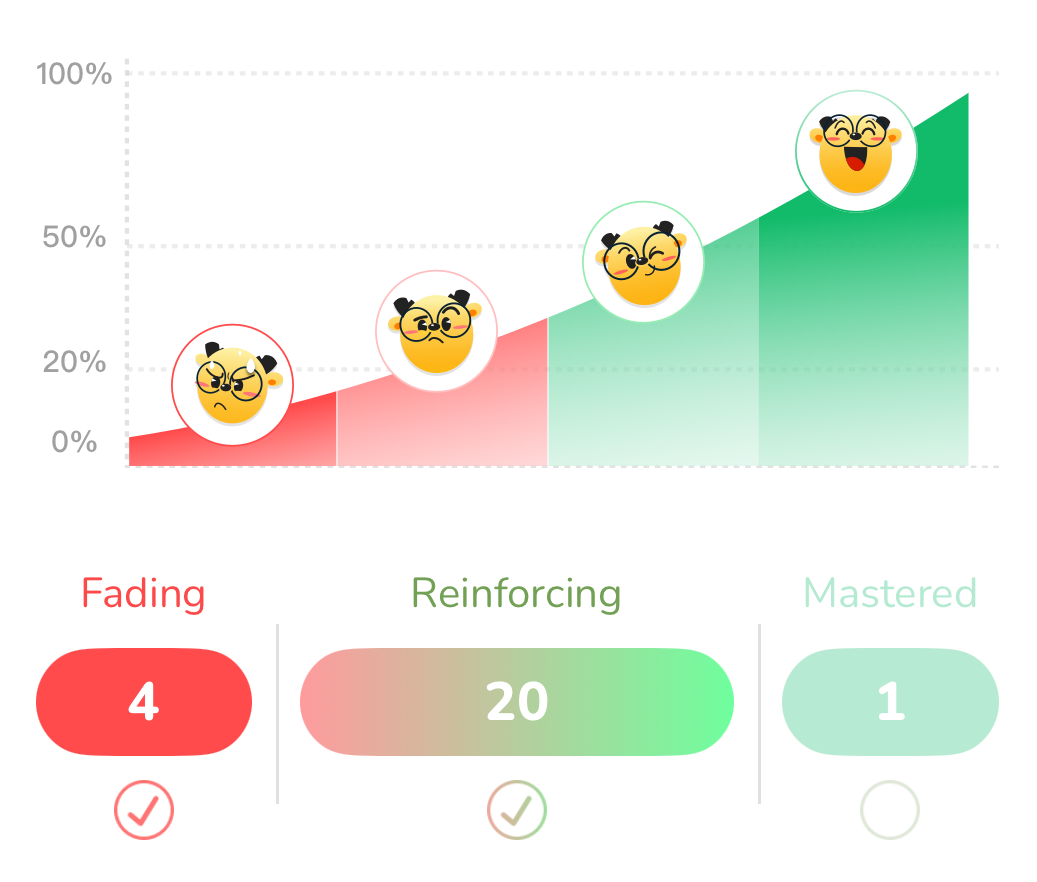
LingoDeer's SRS organizes reviewed items into three mastery levels:
Fading: These are items that may be slipping from memory and need to be reviewed soon.
Reinforcing: You remember these items fairly well, but they still benefit from additional practice.
Mastered: These are items you've reviewed enough times to remember with confidence.
These levels aren't necessarily permanent. An item can move between them as you continue to learn and review, or if you leave it unreviewed for an extended period.
These levels help you see which items need more attention and help the system determine how frequently individual items should appear in your future review sessions.
Combining SRS with Listening, Speaking, and Spelling Practice
Remembering a word is only one part of learning a language. You also need to recognize it when you hear it, pronounce it, and eventually use it yourself.
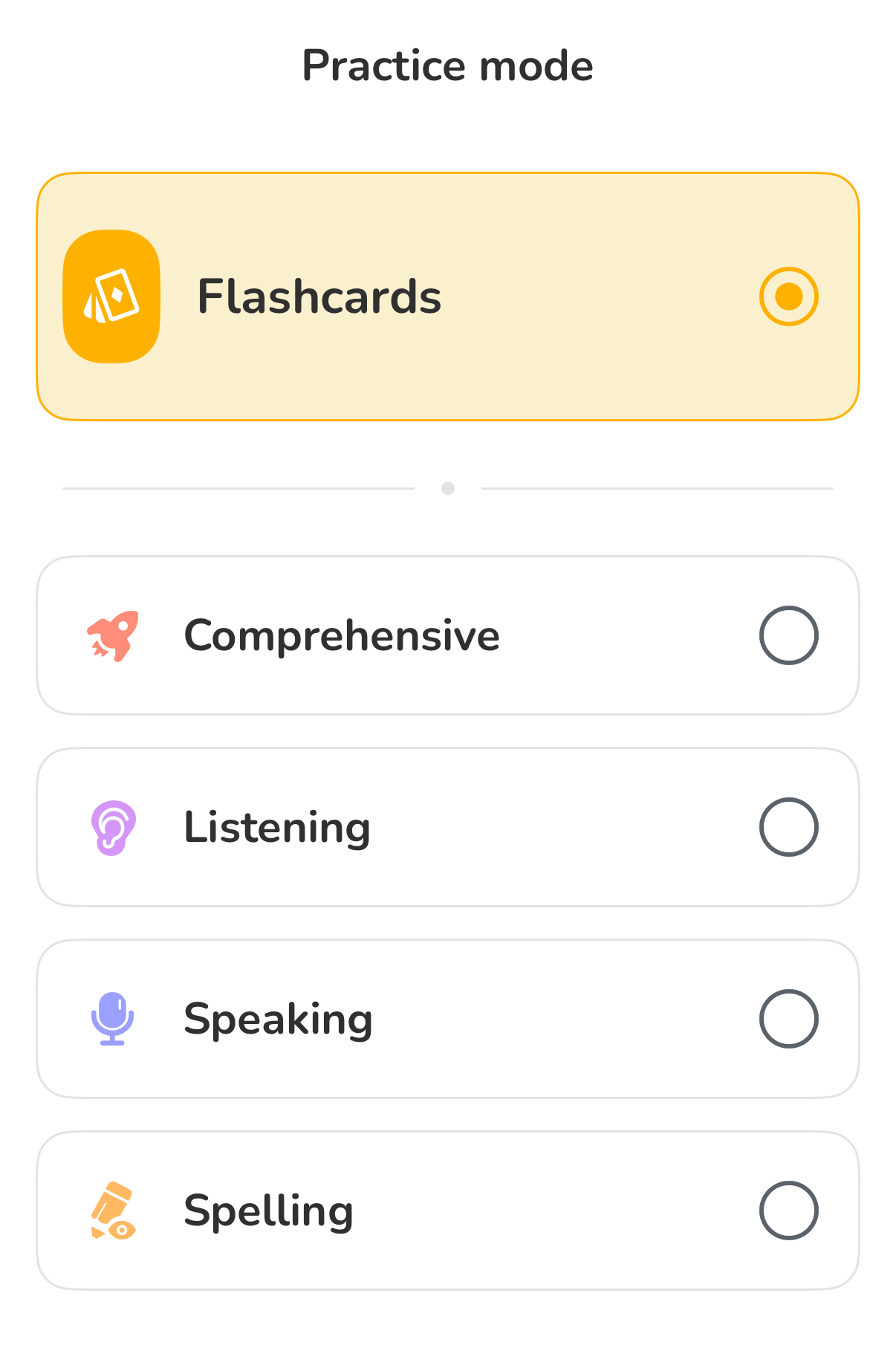
That's why LingoDeer offers five SRS practice modes on its mobile app:
- Flashcards: Review an item at your own pace. The answer is initially hidden, giving you a chance to recall it before revealing the translation.
- Comprehensive: Practice through a variety of exercises that test your understanding of previously learned material.
- Listening: Strengthen your ability to recognize and understand vocabulary through audio-based exercises.
- Speaking: Practice saying words and expressions aloud.
- Spelling: Reinforce your knowledge by recalling and spelling words correctly.
The different modes let you review the same material while practicing different language skills. You can choose listening practice when you have trouble recognizing a word by ear, or spelling practice when you need to work on writing it correctly.
Flexible Reviews That Fit Your Learning Preferences
A good review system should give you structure without making every session feel exactly the same.
LingoDeer offers several ways to customize your reviews:
- Adjust your session size: Choose how many cards you'd like to review in one session.
- Manage new cards: Set a maximum number of new cards to introduce each day.
- Manage your review schedule: View items by unit or review date, and search for specific items.
- Adjust review settings: Depending on the course, choose different display formats, audio settings, and script options.
There's also a separate Custom Review feature for additional targeted practice. You can select particular units, item types, mastery levels, and exercise modes to focus on what you want to practice.
Custom Review is designed for extra practice, while regular SRS Review updates your items' mastery levels and scheduled review dates.
You can follow your scheduled reviews for regular practice and use Custom Review when you want to spend more time on a particular unit or skill.
Making SRS Part of Your Language-Learning Routine
SRS can make vocabulary review more manageable, but consistency still matters. Aim to keep returning to what you've learned over time, rather than completing as many flashcards as possible in one sitting.
Here are a few suggestions for making the most of your reviews:
- Review before moving too far ahead: Spend a little time revisiting previously learned material along with your new lessons.
- Try to recall the answer first: Give yourself a moment to think before revealing a flashcard's translation.
- Be honest about your confidence: Don't mark an item as mastered just because you happened to recognize it once.
- Explore different practice modes: Flashcards are useful, but listening, speaking, and spelling exercises give you additional ways to work with familiar vocabulary.
- Don't worry about getting everything right immediately: Items you find difficult may need more practice.
Language learning is a gradual process. You won't remember every word after one lesson, and that's perfectly normal.
What matters is having a way to revisit what you've learned, recognize your progress, and keep building on your knowledge.
With spaced repetition, every review is another opportunity to strengthen your understanding and make the language a little more familiar.
You can find the SRS exercises available for your course in LingoDeer's Review section. A few minutes of focused review can help you keep practicing what you've learned!
Further Reading & Resources
For readers interested in exploring the science of memory and language learning further:
- The Effects of Spaced Practice on Second Language Learning: A Meta-Analysis – Kim & Webb (2022)
- Distributed Practice in Verbal Recall Tasks: A Review and Quantitative Synthesis – Cepeda et al. (2006)
- How to Remember Anything Forever-ish – Nicky Case, an interactive guide to memory, forgetting, and spaced repetition.
- How Does the Spaced Repetition System (SRS) Work? – LingoDeer Help Center