LingoDeer Booster 101: How to Practice Between Lessons
A practical guide to LingoDeer’s Booster tab, with Korean examples for practicing vocabulary, collocations, grammar, comprehension, fluency, and useful phrases between lessons.
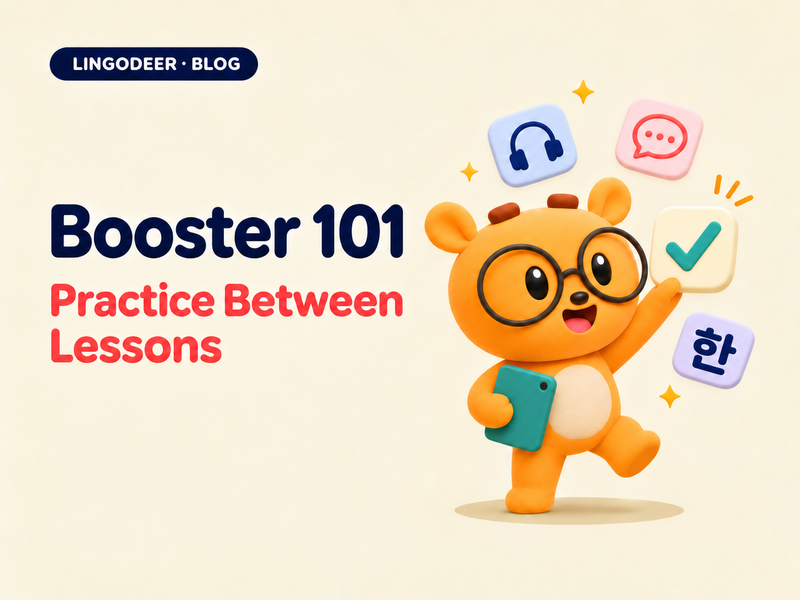
Imagine this: You finish a lesson and get the answers right. A few days later, you miss a familiar word in conversation or hesitate over a verb ending you thought you knew. Those moments tell you what to practice next.
What is the Booster section in LingoDeer?
Booster is the section for extra practice between lessons. It brings together Vocabulary, Collocation, Grammar, and Comprehension drills, plus Fluency Builder and the Travel Phrasebook. Open it when there’s a specific skill you want to work on, such as hearing words you already recognize in writing or applying a grammar rule in a new sentence. This guide uses Korean examples to show how to choose a drill based on what’s giving you trouble. The same approach works in any course with Booster, though the exercises vary by language. As of November 2026, Booster section is available for Korean, Japanese, Chinese, French, Spanish, and German.

“I know the words. Which ones go together?”
Use Collocation drills to learn and practice which words naturally go together. A collocation is a combination of words people commonly use together. In Korean, you might know 이 means “tooth” and 닦다 means “to wipe” or “to clean.” Put them together in 이를 닦다 and you get “to brush your teeth.” For “to feel sleepy,” you can use 잠이 오다, which literally means “sleep comes.” Depending on your native language, some of these collocations may feel counterintuitive at first, and that’s exactly why targeted practice is necessary.

“I know the grammar rule. Why do I keep picking the wrong form?”
Use Grammar drills to work on the specific rule or form you keep getting stuck on. In the Korean course, for example, you can practice word forms and particles separately. For word forms, you might practice when a verb stem drops ㄹ. For example, 만들다 means “to make.” Add the ending -는 to describe someone or something doing the action. The ㄹ drops, giving you 만드는, as in 빵을 만드는 사람 (“a person who makes bread”). For particles, you might practice 은 and 는, which mark what the sentence is about. Use 은 after a consonant, as in 책은 (“as for the book”), and 는 after a vowel, as in 커피는 (“as for the coffee”).

“I recognize the words, but I lose the thread of the conversation.”
Try Fluency Builder when full sentences are hard to follow. It takes you through a dialogue at your own pace, then gives you speaking and writing exercises based on that conversation.
Start with Listen and Learn. Hide the full translation and listen for the main idea. If you lose track, slow the audio down, replay the line, and tap an unfamiliar word to check its meaning. Then listen again at a faster speed and see how much you can follow.
Once you can follow the exchange, try the speaking exercise. The system will give you feedback on your audio input, so you can focus on what needs more practice. Finish with the writing exercise to revisit the lines you just heard and practiced saying.

“I can memorize vocabulary. Can I use it in context?”
Comprehension drills let you test whether you can follow what you read or hear in your target language before seeing the translation. In a “Choose the best match” exercise, use the meaning of the sentence to work out which option fits.
In the Korean exercise below, you read 이것은 귤입니다 (“This is a tangerine”) and choose among 파란색 (blue), 빨간색 (red), and 오렌지색 (orange). The clue is 귤 (tangerine), so the best match is 오렌지색. After you check your answer, the exercise reveals the translation.

“I need a phrase I can say today.”
Use the Travel Phrasebook when you have a specific situation in mind, like ordering at a café or asking for directions. Pick one phrase, listen to the native-speaker audio, and record yourself saying it. In the Korean Phrasebook, open “Food” and try 인기 메뉴로 추천해 주세요 (“Please recommend me some popular dishes”). It’s a phrase you can use when you’re at a restaurant and aren’t sure what to order.

How to fit Booster into your study routine
After your next lesson, pick one thing you hesitated over and spend five minutes on it in Booster. If you mixed up two grammar forms, do a drill on that topic. On a day when you have more time, try a dialogue in Fluency Builder. Use your scheduled SRS reviews alongside those sessions to keep the course material fresh.
Something can make perfect sense during a lesson and still take time to sink in. Coming back to it afterward gives you a chance to see what you remember on your own. The more you practice using what you’ve learned, the easier it is to draw on it without thinking through every step. That’s where the Booster section can help.