Aquí vs Acá: A Guide to Spanish Location Words
Discover the differences between aquí and acá in Spanish. Learn how to use these location words effectively with examples and tips!
If you're learning Spanish, it’s essential to familiarize yourself with the Spanish location words "aquí" and "acá." Both words translate to "here," but have you ever wondered what exactly sets them apart? Why does Spanish have two words for "here"? And to make matters even more intriguing, there are also "ahí," "allí," and "allá," all meaning "there."
Don’t worry! You’re in the right place to unravel these mysterious Spanish location words! In this blog, we'll guide you through the nuances of "aquí" vs "acá" and explain when to use each one. At the end of this blog, we’ll also explore the differences among "ahí," "allí," and "allá." So please read with us until the end!
Let’s break it down together in a friendly and easy-to-understand way!
What’s the Difference Between "Aquí" and "Acá"?
While both "aquí" and "acá" translate to "here," their usage reveals some subtle yet important differences, particularly in terms of precision and movement. Let’s take a closer look at each word.
"Aquí": A Precise Location
"Aquí" refers to a specific, exact location—imagine the very spot you’re standing on right now. It’s like saying, “I am right here.”
- Example: "Estoy aquí en la cafetería."
(I am here in the café.)
"Acá": A General Area
On the other hand, "acá" is more general and often conveys a sense of movement or direction toward the speaker. It invites someone to come closer without pinpointing an exact spot, similar to saying “around here” or “come over here.”
- Example: "Ven acá."
(Come here.)
To truly understand how to use "aquí" and "acá," or even other Spanish vocabulary, immersing yourself in the Spanish language is key. Engaging with authentic Spanish content will significantly enhance your ability to discern when to use each term.
To make the distinction easier, collect examples of aquí and acá from several Spanish-speaking regions. Notice the speaker’s location, whether movement is implied, and how precise the reference is.
How to Use "Aquí"
"Aquí" is the more precise and formal way to say "here" in Spanish. It points to a specific, pinpointed location close to the speaker, making it quite versatile for both formal and informal contexts.
Examples:
- "Estoy aquí en la oficina." (I am here in the office.)
- This sentence conveys a precise location without any movement involved. It emphasizes that the speaker is currently situated at a specific place—the office—indicating both presence and exactness. The use of "aquí" highlights the immediacy of the location, making it clear that the speaker is physically at that location.
- "Deja tu mochila aquí." (Leave your backpack here.)
- In this example, "aquí" is used to direct someone to place their backpack at a specific spot. This sentence points to an exact location where the action should take place, showcasing how "aquí" is effective for giving precise instructions. It implies that the speaker is designating a particular area for the backpack to be left.
- "Aquí se prohíbe fumar." (Smoking is prohibited here.)
- This phrase is often found in formal contexts, such as signs or official statements. Using "aquí" reinforces the location where the prohibition applies, making it clear that smoking is not allowed in that specific area. The formality of the phrase reflects its common usage in written Spanish, particularly in regulations or guidelines, making it suitable for various public spaces.
Common Phrases with "Aquí":
- "Estoy aquí." (I’m here.)
- "Quédate aquí." (Stay here.)
- "Aquí tienes tu respuesta." (Here’s your answer.)
How to use "Acá"
"Acá" is also a way to say "here," but it’s more general and often used in contexts that involve movement or direction. It’s widely used in Latin America, especially in more informal situations. "Acá" can describe an area near the speaker but isn’t as precise as "aquí."
Examples:
- "Ven acá." (Come here.)
- This phrase uses "acá" to indicate a movement toward the speaker. It invites someone to approach, suggesting a sense of urgency or immediacy. Unlike "aquí," which emphasizes a specific point, "acá" is more about the general area and the action of moving closer. It's commonly used in informal contexts, particularly in Latin American countries, where it conveys a friendly invitation to come closer.
- "Por acá todo está tranquilo." (Around here, everything is calm.)
- In this example, "por acá" refers to a general location surrounding the speaker. The phrase suggests a broader area rather than pinpointing a specific spot. It conveys a relaxed atmosphere, indicating that the surroundings are peaceful. This expression is often used in everyday conversation to describe the environment in a casual and approachable manner.
- "¿Quién vive por acá?" (Who lives around here?)
- This question utilizes "por acá" to inquire about residents in the vicinity. It is commonly used in casual speech, especially in Latin American countries, reflecting a conversational tone. The phrase implies familiarity with the area and invites dialogue about the community. By using "por acá," the speaker indicates a general interest in the neighborhood rather than a specific address.
Common Phrases with "Acá":
- "Ven acá." (Come here.)
- "Mira acá." (Look here.)
- "Por acá." (Around here.)
You might have noticed that "aquí" and "acá" vary regionally. In Spain, "aquí" is more commonly used in everyday conversation, while "acá" is prevalent in Latin American countries like Mexico, Argentina, and Colombia.
More Spanish Location Words: "Ahí," "Allí," and "Allá"
Besides "aquí" and "acá", there are also "ahí," "allí," and "allá," all of which mean “there.” How to use them correctly? Let’s also take a closer look at these Spanish location words.
1. "Ahí" (There, but Nearby)
"Ahí" refers to something that is "there," close to the person you’re talking to, but not as close to you. It’s like saying "there" when pointing at something nearby.
- Example: "El libro está ahí, en la mesa."
(The book is there, on the table.) - In this example, "ahí" refers to a spot that’s not right in front of you but still within reach.
2. "Allí" (Over There, Specific Location)
"Allí" is used to talk about a more distant location, but still within sight. It’s like saying "over there," where you can point to something specific but further away.
- Example: "Te espero allí, en la esquina."
(I’ll wait for you over there, at the corner.) - It’s a specific place but not close by.
3. "Allá" (Far Away or General Area)
Finally, "allá" refers to a distant location, usually outside the immediate surroundings, or it can indicate a more abstract or broad area. Think of it as "way over there."
- Example: "Allá en las montañas hace frío."
(Over there in the mountains, it’s cold.) - "Allá" suggests that the mountains are far away, possibly out of sight or in a general area.
Summary of Aquí, Acá and more
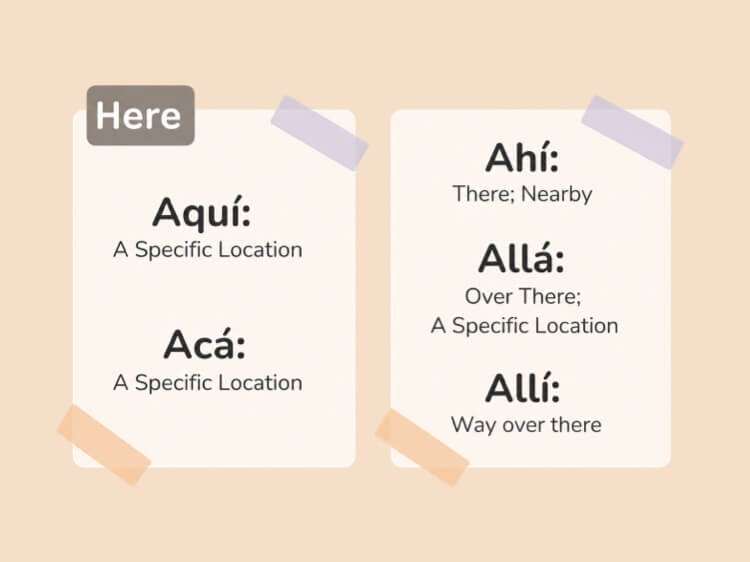
Here’s a quick reference chart summarizing these Spanish location words:
| Term | Translation | Explanation |
| Aquí | Here | Precise, exact location, close to the speaker. |
| Acá | Here | General area or motion toward the speaker. |
| Ahí | There | Near the listener, but not as close to the speaker. |
| Allí | There | Specific, farther location but within sight. |
| Allá | Over there | Far away, broad or distant location. |
Practice Aquí and Acá in Context
Practice aquí, acá, and other location words with short scenes: describe where an object is, invite someone to move closer, and compare how speakers from different regions phrase the same idea.
https://videopress.com/v/eOcKI798?resizeToParent=true&cover=true&preloadContent=metadata&useAverageColor=true
Next time you need to describe things that are here, there, over there, or even farther away, recall these Spanish location words and incorporate them into your everyday conversation!
Related posts: