[A VS B] あまる vs のこる, More Than Needed or Still Remaining?
Learn how amaru emphasizes surplus beyond what is needed, while nokoru describes what remains, including food, work and time.
JAPANESE · BEGINNER
“We have three sandwiches left” could mean that everyone has had enough, or that some people are still waiting for lunch. Both 余る and 残る can describe something that is left. Choosing between them depends on how you view that remainder.
In this guide
The quick difference
余る
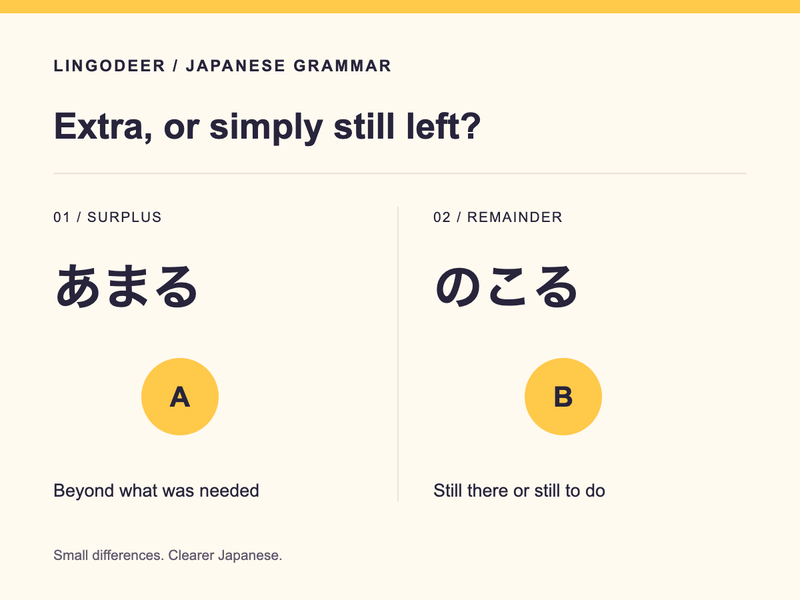
Be left over / have some to spareFocus on the amount beyond what is needed.
残る
Remain / still be leftFocus on what is still there or still to do.
What counts as extra?
At the end of lunch, everyone has had enough and three sandwiches are still on the tray. You can use 余る to emphasize that you brought more food than the group needed, or 残る to report the sandwiches still on the tray. Both fit this situation; the choice changes what you emphasize.
If some people have yet to receive their lunch, the sandwiches still on the tray may be needed. 残る lets you describe that remaining food without calling it extra. Knowing that something remains is not enough to decide that it is surplus.
For time, the comparison is with the time a task requires. 時間が余る presents time as spare, as when you finish early. 時間が残っている describes time still available before a deadline. You can say this while working or after finishing; the verb alone does not establish completion.
残る also describes unfinished tasks. In 片付けがまだ残っています, the cleanup still needs doing. This is work awaiting completion, so the idea of an extra, unused amount does not express the intended meaning.
Both verbs are intransitive: the food, materials, time, or work is the subject, commonly marked with が.
See it in context
01The same sandwiches, two viewpoints: At a picnic, everyone has received the sandwiches they wanted. You can describe the portions left on the tray as extra food or tell a friend how many are still there.
Example 1
全員に配っても、サンドイッチが余りました。
Even after we gave some to everyone, there were sandwiches left over.
Example 2
サンドイッチがまだ三つ残っています。
There are still three sandwiches left.
02Spare supplies and unfinished work: You have finished making the decorations. Some material was unnecessary, but tools and scraps still need putting away.
Example 3
材料が少し余りました。
We had a little material left over.
Example 4
片付けがまだ残っています。
There is still some cleanup left to do.
03Spare time and remaining time: Maya and Ben have the same deadline. Maya has finished and wants to describe her spare time. Ben is still working and wants to reassure a classmate that there is time to continue.
Example 5
早く終わったので、時間が余りました。
I finished early, so I had time to spare.
Example 6
締め切りまで、まだ時間が残っています。
There is still time left before the deadline.
Try it yourself
Answer key and explanations
- プリントが余っています。 — 余っています highlights the extra copies beyond the number the class needed. 残っています is also natural here, but it reports that copies are still there without emphasizing the surplus.
- サンドイッチがまだ三つ残っています。 — 残っています reports the sandwiches still available for lunch. 余っています would present the three as extra portions, which goes beyond the count you want to give. It would fit a different intention, such as saying you prepared more food than everyone needed.
- 時間が余っています。 — 余っています presents the time as more than the completed assignment required. 残っています can also describe time still available, but it does not by itself tell a listener that you have finished and have time to spare.
- There is time available before the deadline; the assignment may be finished or unfinished. — 残っています tells you that time remains until the deadline. Completion needs separate information, so the claim that the assignment is finished is not supported by this sentence.
What to remember
- Both verbs can describe something left. Choose 余る when you want to emphasize an amount beyond what is needed, and 残る when you want to report what is still there or still to do.
- When the remainder is extra, either verb may fit with a different emphasis.
- Remaining work still needs doing.
- Remaining time alone does not tell you whether the task is finished.