A Beginner's Guide to the German Alphabet
Learn the German alphabet with this simple guide! Explore the pronunciation, tips, and resources to kickstart your German learning!
Learning the alphabet is the first step in learning any new language. Luckily, the German alphabet (das Alphabet) shares many similarities with English. But it also has some unique features that are important to understand. So in this guide, we’ll explore the German alphabet, its pronunciation, and helpful tips for mastering it!
The Basic Alphabet in German
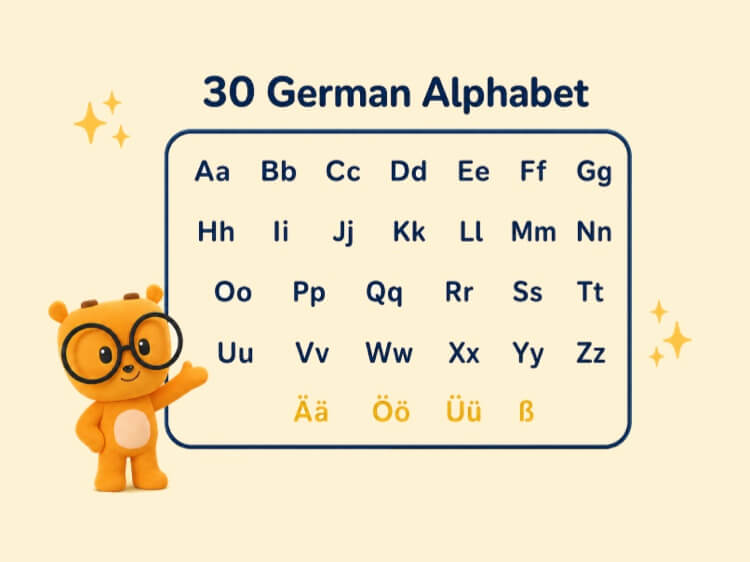
The German alphabet consists of 26 letters, just like in English. Here’s a quick overview:
| German Letter | Phonetic Spelling | Example Word |
| A | ah | Apfel (apple) |
| B | beh | Bruder (brother) |
| C | tseh | Computer (computer) |
| D | deh | Deutschland (Germany) |
| E | eh | Elefant (elephant) |
| F | eff | Freund (friend) |
| G | geh | Gitarre (guitar) |
| H | hah | Haus (house) |
| I | ee | Insel (island) |
| J | yot | Jahr (year) |
| K | kah | Katze (cat) |
| L | ell | Lampe (lamp) |
| M | em | Mutter (mother) |
| N | en | Nacht (night) |
| O | oh | Ohr (ear) |
| P | peh | Park (park) |
| Q | kuh | Quiz (quiz) |
| R | err | Rose (rose) |
| S | ess | Sonne (sun) |
| T | teh | Tisch (table) |
| U | oo | Uhr (clock) |
| V | fau | Vogel (bird) |
| W | veh | Wasser (water) |
| X | iks | Xylophon (xylophone) |
| Y | ypsilon | Yoga (yoga) |
| Z | tset | Zahn (tooth) |
Pronunciation Differences Between German and English
While many letters in the German alphabet sound familiar, some have different pronunciations compared to English. Let's check the key ones with audio:
- C: Pronounced like "ts," as in Celsius.
- J: Sounds like "y," as in Jahr (year).
- U: Pronounced like "oo," as in Uhr (clock).
- V: Pronounced like "f," as in Vater (father).
- W: Sounds like "v," as in Wasser (water).
- Y: Pronounced like “i”, as in Yoga (yoga).
- *Y: Also pronounced like “u”, as in typisch (typical).
- Z: Pronounced like "ts," as in Zahn (tooth).
Special Characters in the German Alphabet: Umlauts and Eszett
One unique aspect of the German alphabet is its special characters, namely the Umlauts (Ä, Ö, Ü) and the Eszett (ß).
Umlauts in German
Umlauts are modified vowels that change the sound of the letter:
- Ä: Sounds like “e” in bed, as in spät (late).
- Ö: This is a tricky one, probably the most difficult German umlaut, because it doesn’t really exist in English. So, let’s just check the audio for the example word: Löwe (lion).
- Ü: A rounded version of “u,” as in üben (practice)
Eszett (ß) in German
The Eszett, known as the sharp S, is pronounced like a double “s.” It’s typically found in words like Straße (street) and is never used at the beginning of a word.
Here are some examples of German words containing ß:
Straße (street)
Fuß (foot)
weiß (white)
Spaß (fun)
Maßnahmen (measures)
In informal contexts, especially on social media, you might see the letter ß replaced by "ss." This substitution simplifies typing and may be seen in usernames or hashtags. For example, Straße might appear as Strasse. However, this is not grammatically correct in formal writing and can change the meaning of words, so use each form appropriately.
Learning Tips for the German Alphabet
To effectively familiarize yourself with the German alphabet, here are some practical tips:
- Listen and Repeat: Engage with audio resources, like recordings of native speakers pronouncing the alphabet, to help you grasp the distinct sounds of both vowels and consonants. This helpful YouTube video is a great resource for learning the pronunciation of the German alphabet!
https://www.youtube.com/watch?v=axQGCdGCjAk
- Practice with Words or Expressions: Read simple German words aloud, focusing on the pronunciation of each letter. Watching German movies and TV series can also improve your listening skills and pronunciation. Replay short passages, repeat key expressions, and compare your pronunciation with the speakers.
- Flashcards: Create flashcards featuring each letter along with example words. This visual aid can accelerate your memorization of sounds.
- Language Apps: Apps such as Duolingo, Babbel, and Anki offer interactive exercises that can support German alphabet practice. Use them alongside focused listening and speaking practice.
Conclusion
The German alphabet sets the foundation of your German language journey. Put some effort into the special characters and pronunciation differences from English, and you’ll soon find learning German is actually fun!
Related posts: