Mastering Direct Pronouns in French: A Comprehensive Guide
Learn how to master direct pronouns in French with this comprehensive guide, and make your daily conversations with more clarity!

In French, pronouns are a key part of daily conversation and are essential for speaking fluently. If you’ve been learning French for a while, you’ve probably come across direct pronouns and wondered how to use them correctly. Well, you’re in the right place! In this guide, we’ll break down everything you need to know about direct pronouns in French, from what they are to how to use them in sentences. By the end, you’ll be ready to incorporate them smoothly into your conversations. Let’s get started!
What Are Direct Pronouns?
Let’s start with the basics. A direct pronoun is a word that replaces a direct object in a sentence. What does that mean? Well, a direct object is the noun that receives the action of the verb directly. For example, in the sentence "I see the book," "the book" is the direct object because it’s what you see. In French, instead of repeating "the book" (le livre), you can replace it with a direct pronoun.
Here’s a quick list of the French direct pronouns:
- me (m’) – me
- te (t’) – you (informal)
- le (l’) – him, it (masculine singular)
- la (l’) – her, it (feminine singular)
- nous – us
- vous – you (formal or plural)
- les – them (masculine or feminine plural)
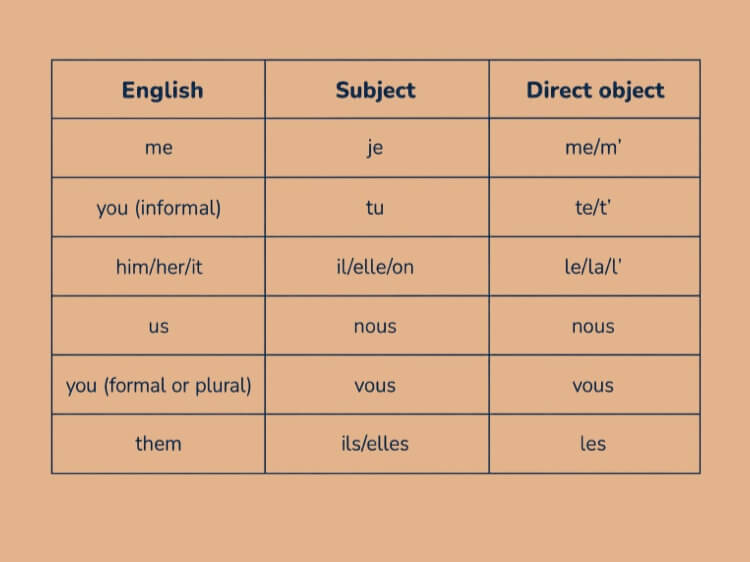
These pronouns are super handy and can save you from repeating yourself!
When to Use Direct Pronouns
Now that you know what direct pronouns are, when should you use them? You’ll use a direct pronoun when you want to avoid repeating a noun that’s already been mentioned or is obvious from context.
Let’s take this sentence as an example: "Il y a un chat, je vois le chat." (There is a cat, I see the cat.) Instead of saying, "le chat" again, you can say, "Je le vois." (I see it.)
Here are a few more examples:
- "Elle mange une pomme." (She is eating an apple.) → "Elle la mange." (She is eating it.)
- "Nous aimons nos amis." (We love our friends.) → "Nous les aimons." (We love them.)
Notice how the direct pronoun goes before the verb? That’s key in French!
Placement of Direct Pronouns in a Sentence
Placement can sometimes trip people up, but it’s simpler than it seems. Generally, direct pronouns are placed directly before the verb they relate to.
In simple sentences:
- "Il prend le livre." (He takes the book.) → "Il le prend." (He takes it.)
With infinitives: If there’s an infinitive verb in the sentence, the direct pronoun goes before the infinitive.
- "Je vais acheter la robe." (I’m going to buy the dress.) → "Je vais l’acheter." (I’m going to buy it.)
In compound tenses like the passé composé: The direct pronoun is placed before the auxiliary verb (avoir or être).
- "Elle a vu le film." (She saw the movie.) → "Elle l’a vu." (She saw it.)
With negative sentences: In negative sentences, the direct pronoun is still placed before the verb, but it’s within the ne…pas structure.
- "Je ne vois pas la maison." (I don’t see the house.) → "Je ne la vois pas." (I don’t see it.)
These rules apply in most situations, so keep them in mind when structuring your sentences.
Agreement of Direct Pronouns
One of the trickier aspects of using direct pronouns in French is making sure they agree in gender and number with the noun they replace, especially in compound tenses like the passé composé.
Here’s the rule: when the direct pronoun comes before the verb in a compound tense, the past participle has to agree with the pronoun in gender and number.
Let’s break that down:
- "Elle a vu le film." (She saw the movie.) → "Elle l’a vu." (She saw it.) – No change because "film" is masculine and singular.
- "Elle a vu la voiture." (She saw the car.) → "Elle l’a vue." (She saw it.) – Notice the extra "e" because "voiture" is feminine.
- "Elle a vu les films." (She saw the movies.) → "Elle les a vus." (She saw them.) – Notice the "s" for the plural.
Getting the agreement right can take a bit of practice, but with time, it will become second nature!
Using Direct Pronouns in Questions and Imperatives
Direct pronouns also have their place in questions and commands.
In questions:
- "Tu vois le pain ? " (Do you see the bread?) → "Le vois-tu ?" (Do you see it?)
Or in more casual conversation:
- "Tu le vois ?" (You see it?)
In affirmative imperatives: The pronoun is attached to the end of the verb with a hyphen.
- "Prends le livre ! " (Take the book!) → "Prends-le !" (Take it!)
In negative imperatives: The pronoun goes back before the verb.
- "Ne prends pas le livre!" (Don’t take the book!) → "Ne le prends pas!" (Don’t take it!)
These small changes in structure are important to remember when forming questions or giving commands in French.
Reading level-appropriate French will help you recognize direct pronouns in context. Mark the noun each pronoun replaces, then rewrite the sentence with a different noun to test the same pattern.