


If you’d like to be able to learn a language on the go, we’ve got a headache-saving shortcut for you — we have researched and tested the popular language learning apps currently to string together a list of the 8 most viable and credible options. Now read on to find out what are the 8 best language learning apps!
What We Look For in Language Apps
1. Language-specific curricula
2. Audio quality
3. Contexts and explanations
4. Exercise design
5. Value
Each app has its own perks and purpose, so take a look at the details for each app down below and see which you’d like to try out.
1. Duolingo: Largest Community for Language Learners


Memberships for Duolingo, the most popular language-learning app available, start from $0. That’s right — you can get started for free. The game-like experience and creative (sometimes threatening) notifications do a great job at motivating you to stay on track and maintain consistency.
Duolingo’s teaching method is a ‘laissez-faire’ system, meaning that users are expected to figure out the patterns and rules through repetitive translation exercises. Since its courses are created by volunteers who may or may not be trained in language pedagogy, the quality of the lessons is not guaranteed and will likely vary. Many complain that they come across bizarre sentences and/or ineffective exercises, while the robotic audio can prove rather unpleasant and demotivating. To summarize, Duolingo is best suited to casual learners who are looking for a free option and not in a hurry to progress.
2. LingoDeer – Best Standalone Language App


LingoDeer is the nerdy cousin of Duolingo’s green owl mascot. His black-rim glasses give him the look of a shining GPA 4.0 student, which is reflected in the app’s incredibly high 4.8/5 user rating. Its logical curricula, effective exercises, clear audio and grammar explanations offer a new approach to language apps.
Each unit offers substantial “learning tips” with examples and explanations, which are crucial for learning languages that are very different from your own. For the Asian language courses, it even allows users to switch between writing systems. In every detail you can tell LingoDeer is very serious about teaching.
So, why isn’t LingoDeer more popular than Duolingo? The answer is simple: it isn’t free, and it’s fairly new. LingoDeer was introduced in 2017 and its memberships starts at $9-15/mo. However, the quality of language learning can be more accurately guaranteed than that of free providers, seeing as LingoDeer has been developed by qualified linguists.
Overall, LingoDeer is best for users who want to learn with a more logical, block-building approach and progress more efficiently. LingoDeer also provides a practice app LingoDeer Plus with which you can practice a variety of language skills intensively.
3. Anki: Best Free SRS Flashcard App
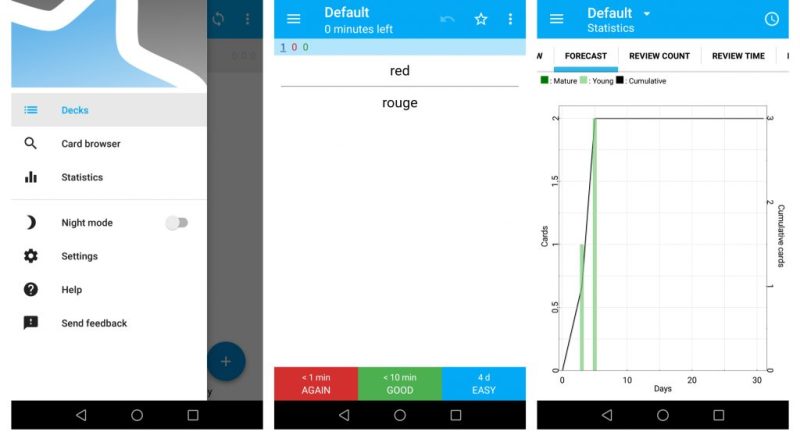
When it comes to memorizing new vocabulary, Anki is the specialist you should employ. The great benefits of using Anki are rooted in the use of SRS (Spaced Repetition System). Getting started with Anki does require a bit of patience, but there are plenty of pre-made vocabulary packs that you can import directly. So, Anki is recommended for those who are cramming for tests and hope to expand their word bank rapidly and strategically.

4. Drops: Best Vocabulary Game
Drops is the direct opposite of Anki – simple to use and visually engaging. New words slide down from the top of the screen like raindrops, and you get two options: discard them because you already know their meaning or add them into the little brain icon. For the words identified as new, you are then prompted to associate the words with the right illustrations, spell the words by ordering the syllables and repeat these small exercises a few times.
Unlike Anki, Drops does not give you the flexibility to create your own list or add any word to the lists curated by the Drops team. To make sure that you memorize them in the long run, you will also need to review the words on a regular basis. It is a suitable app for casual learners to pick up a few words every day, a learning style that resonates with the saying “many drops make an ocean.”


5. Babbel: Best European languages learning app
Babbel is also a language learning app that offers paid courses and, like LingoDeer, allows you to learn whenever and anywhere you like. Moreover, Babbel majors in offering more niche European languages such as Danish and Dutch. In addition, the internal game is somewhat motivating, as you can earn bonus time after meeting your daily goals!
Similarly, Babbel has its own drawbacks, such as the absence of popular Asian languages like Japanese and Chinese. Meanwhile, although Babbel offers systematic grammar teaching, the lessons are less articulated and less suitable for beginners. Another big flaw is its price. While LingoDeer costs $119 to buy the lifetime membership, Babbel costs $388 to unlock for only a single year, which many users find prohibitively expensive.


6. LingQ: Best for Immersive Learning
LingQ’s motto is “Nobody can teach you a language, you have to learn it yourself”, implying that anyone learning a language is the utmost expert in what they know or do not. The lesson begins with a text of your choice. Words that are supposedly unfamiliar are highlighted in blue. Then, you link these blue words to the translations submitted by the LingQ user community (hence the name of the app, which is actually pronounced “link”). The blue words then turn into yellow and reappear in following lessons. As you get more and more familiar with the words, you can then mark the words as known.
LingQ’s method requires a complete beginner to work through texts with plenty of new words independently. For this reason, LingQ is better suited for intermediate students who already know the basics of the language.


7. HelloTalk: Best Language Buddy Finder
HelloTalk is one of the best tools out there to feel like the whole world fits in the palm of your hand. The idea behind the app is a very simple concept: chat with natives and exchange feedback. It is a WhatsApp look-alike tool just for the language learning community.


What makes it really interesting are the features that instantly translate, look up words or correct mistakes in the messages you exchange. And it also has a news feed like Facebook’s where you can read short posts shared by your language buddies and get corrections and comments. For intermediate or advanced students, it is a virtual immersion program at your fingertips.
8. Memrise: Best learning in real situations.
The most significant advantage of Memrise is that it offers many recorded videos of native speakers. This helps you to experience and quickly master each phrase through real situations. Also, Memrise contains built-in incentives, such as setting memorization as planting the flowers and setting review as watering. Furthermore, Memrise pushes you to think deeply rather than simply memorize. In the few minutes of each learning, you need to be 100% committed to grasping a new foreign language’s idea.
Unfortunately, although Memrise boasts of being a course designed by linguists, many learners still point out faults during learning. Simultaneously, the courses for some languages lack systematization, such as Arabic, where words are not marked in singular and plural. It requires a certain level of identification on learners. Likewise, there is no practice for French verb conjugations, as long as learners memorize them according to sentences. For example, “Je parle l’anglais.” is studied without mentioning that the original form of parle is parler.


Final Thoughts on Learning Languages with Apps
On both the Apple App Store and Google Play Store, there are hundreds of language learning apps to choose from. However, it is really time-consuming to download each one of them and test them out. As app developers ourselves, we can tell the developers of these eight apps genuinely understand the true needs of language learners, as is reflected in the effectiveness of their applications.
We hope our review has helped you to understand their unique specialties and how to make most out of apps in general when learning a new language.