Avoir: the French Super Verb
Discover the super verb in French - "avoir"! Learn about its conjugation, uses, common expressions, and idiomatic phrases.
There is a super verb in French - can you guess it?
Yup, it’s avoir! Meaning "to have," this irregular verb is one of the most essential and frequently used words in French, appearing in a variety of contexts. Mastering avoir can lay a strong foundation for your French proficiency. Here, we’ll walk through its conjugation, various uses, common expressions, and idiomatic phrases to deepen your understanding of this verb.
1. Conjugation of avoir
Below is the present tense conjugation of avoir.
| Pronoun | Conjugation |
| J’(Je) | ai |
| Tu | as |
| Il/Elle/On | a |
| Nous | avons |
| Vous | avez |
| Ils/Elles | ont |
Examples in sentences:
- J'ai un chat. (I have a cat.)
- Tu as un frère. (You have a brother.)
- Il a un chien. (He has a dog.)
- Nous avons une maison. (We have a house.)
- Vous avez un jardin. (You have a garden.)
- Ils ont des amis. (They have friends.)
2. Usage of avoir
Possession - When you want to say someone has something, you can use avoir followed by the noun that represents what is being possessed. This is similar to how "to have" is used in English.
Examples:
- J'ai un livre. (I have a book.)
- Elle a une voiture. (She has a car.)
Age - In French, age is expressed using the verb avoir (to have) rather than the verb "être" (to be) as in English. Therefore, instead of saying "I am 20 years old," you would say "I have 20 years" in French.
Examples:
- J'ai vingt ans. (I am twenty years old.)
- Mon frère a quinze ans. (My brother is fifteen years old.)
Obligation - The phrase avoir à is used to indicate an obligation or necessity to do something. It is similar to the English expression "to have to" or "to need to." This construction involves using the phrase plus an infinitive verb.
Examples:
- J'ai à finir ce travail. (I have to finish this work.)
- Tu as à parler avec le professeur. (You have to talk with the teacher.
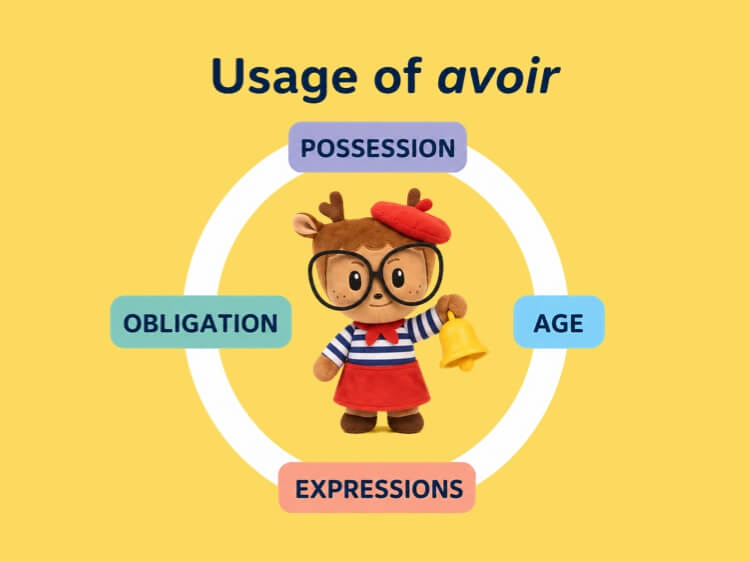
Common Expressions with avoir - The verb avoir is used in many common expressions to convey various states, conditions, or feelings.
- Avoir faim (to be hungry): J'ai faim. (I am hungry.)
- Avoir soif (to be thirsty): Nous avons soif. (We are thirsty.)
- Avoir chaud/froid (to be hot/cold): Elles ont chaud/froid. (They are hot/cold.)
- Avoir peur (to be afraid): Tu as peur. (You are afraid.)
- Avoir besoin de (to need): J'ai besoin de toi. (I need you.)
- Avoir envie de (to want): Elle a envie de partir. (She wants to leave.)
- Avoir l'air (to seem/appear): Tu as l'air fatigué. (You seem tired.)
- Avoir lieu (to take place): La réunion a lieu demain. (The meeting takes place tomorrow.)
- Avoir raison/tort (to be right/wrong): Tu as raison/tort. (You are right/wrong.)
- Avoir de la chance (to be lucky): Elle a de la chance d'avoir gagné. (She is lucky to have won.)
3. Avoir in Compound Tenses
In French grammar, avoir serves as an auxiliary (helping) verb when forming compound tenses, such as the passé composé. Compound tenses combine a form of avoir with the past participle of the main verb. This construction is used to indicate completed actions or events that happened in the past.
Basic Structure:
Subject + conjugated form of avoir + past participle of the main verb
Examples:
- J'ai mangé. (I ate / I have eaten.)
- Ils ont vu le film. (They saw the movie / They have seen the movie.)
Now, are you feeling more confident with this super verb? Try these practice exercises and check your answers below.
Exercise:
1. Conjugate the verb avoir in the present tense according to the subject provided.
- J’ __________ un chien.
- Tu __________ faim.
- Elle __________ froid.
- Nous __________ de la chance.
- Vous __________ raison.
- Ils __________ peur des araignées.
Answers:
- ai
- as
- a
- avons
- avez
- ont
2. Form the passé composé using avoir as the auxiliary verb and the correct past participle for each sentence.
- Elle __________ (manger) une pomme.
- Nous __________ (regarder) un film hier soir.
- Tu __________ (acheter) un cadeau pour ton frère.
- Ils __________ (étudier) toute la nuit.
- J' __________ (lire) ce livre plusieurs fois.
- Vous __________ (visiter) Paris l'année dernière.
Answers:
- a mangé
- avons regardé
- as acheté
- ont étudié
- ai lu
- avez visité
Did you answer the questions correctly? Keep practicing and using it in different sentences to further strengthen your French power!