

It’s no secret that learning a language independently is hard work. So, to take some of the weight off your shoulders, we’ve written a step-by-step guide to teach you the best way to learn a language. We’ll be addressing the necessary steps to language success, the most efficient and effective learning plan, and all the ingredients you need to supplement your determination.
Preparing to Learn a Language
The phrase “measure twice, cut once” couldn’t be more relevant than it is here. Preparing yourself for the journey ahead puts you miles in front of most language learners. Our first four tips address determining your focus, selecting your tools, setting goals, and preparing your environment.


Step 1: Setting the Main Focus
Before anything, you need to know what it is you’re doing and why you’re doing it. Having too many options can cause hesitancy and procrastination, so we cut that out first.
Ask yourself the following:
- Which language am I going to learn?
- Why do I want to learn this language? How will I use it?
Yes, answering the first question is obviously essential. But the second question is just as important. It’s crucial to have a clear understanding of what you would like to achieve with the language as this will help you gear your learning methods toward your end goal. Each journey differs depending on the reasoning for the learner’s desire to learn a language.
Step 2: Picking Your Tools
There are a lot of tools on the market for beginners to choose from. We recommend you choose one source as the main guide that navigates you through the basic framework of your chosen language. After that, we recommend you use other resources for supplementary practice.
There are so many ways to start learning and it’s important that your primary tool/source is well suited to your personal needs and preferences. Good questions to ask yourself are:
- Do I prefer independent study or sitting in a classroom?
- Do I like textbooks or applications better?”
For textbook and app reviews, we recommend Nick’s All Language Resources blog. Nick writes extensively on popular learning resources and provide an in-depth analysis. You can also see our guide to The 8 Best Language Learning Apps.
Step 3: Preparing Your Environment
One of the things people often overlook when mapping out their journey to language success is the influence of their physical environment. Here, we’ll give you advice on how to make your environment more study-friendly!
Study In The Same Area
When you have one particular area designated for language learning, your brain will immediately hop into learning mode as soon as you enter it, instead of spending time distracted. Make sure that this area is compatible with how you study. For example, you might prefer studying on your couch at home or at a coffee shop with some background noise. Make sure you’re going to be comfortable where you’re at.
By going to the same spot to study, you prime yourself for studying instead of doing something else. Keep your study area consistent, that way you won’t have to think twice about finding a place to study at.
Remove All Distractions
This should be blatant, but many people don’t follow it. Removing all your distractions helps you focus on the task at hand. Yes cat videos are hilarious, but distractions will only prolong your learning process and demotivate you.
Some things you can do to eliminate distractions:
- Set your phone to silent
- If you’re studying online, remove all the distracting tabs on your laptop and turn off the notifications
- Turn off the TV or music if you find these things distracting
- If you’re at home and your family are too, close the door and isolate yourself
We want high-quality study time. You can either work long or work smart, and working smart is the best choice there is for those on a time crunch.
Prepare In Advance
If you know you’re going to be studying, set out the materials you need beforehand so that it’s easier for you to jump right in. Much like working out at the gym, it can sometimes even take longer to get yourself prepared than it does to do the actual workout. With that in mind, here are some examples to get you into the flow of studying.
- If you’re going to be studying on your laptop, open up the applications/websites before closing your laptop. Then, once you’re ready to study at your favorite coffee shop, you can just open up and start moving along!
- If you know you’ll be studying at your desk tomorrow morning, prepare the materials you want to use the night before. When the morning comes, you can get right into studying without having to get distracted by menial tasks.
When you prepare these things in advance, you remove the friction from starting (which could otherwise cause hesitation) and make it easier to flow right into it.
Step 4: Making SMART Goals
Once you have established your end goal, picked the tools and found your favorite places to study, it’s time to master the secret recipe for getting things done – the SMART planning. SMART planning is one of the best productivity hacks. Here is what each letter stands for and what they mean when setting a goal.
- S = Specific – Make your goal as specific as possible
- M = Measurable – Provide a way to evaluate your goals using data and metrics
- A = Achievable – Make sure your goal is achievable to you
- R = Realistic – Your goal has to relate to the main focus and not something else
- T = Time-Bound – Give yourself a reasonable deadline to complete it by
SMART goals are only useful if you write them down and keep them where you can see them every day. A constant reminder will force you to keep going. Keep them on your laptop, write them into your phone, or write them on a sticky note and place it where you’ll see it every day! The more you remind yourself, the more you can stay on track.
Here are some great SMART goal examples:
- I will learn 25 Japanese words every other day so that I can talk about Pokemon Go with a native speaker in two months’ time
- I will practice reading Spanish news every day for one hour after I get home using Spanish news sites for 30 days
- From Monday to Friday, I will spend 20 minutes on my way to school learning new Portuguese words to get a vocabulary of at least 2000 words
You are not limited to just one goal, either. You can break them down into subcategories to make sure you’ve covered all your bases! But remember to keep them “achievable” and “realistic”. Visualise your end goal each day and remind yourself that your SMART goals are the key to getting there.
How to Learn a Language: Execution
Now that we’ve covered all the prep work, let’s get to the real work of learning a language: the execution of your learning program. The day-to-day plan varies with each person; the key to a successful one is to design it to work around your schedule and then stick with it consistently. The final four steps in our guide will focus on this element.
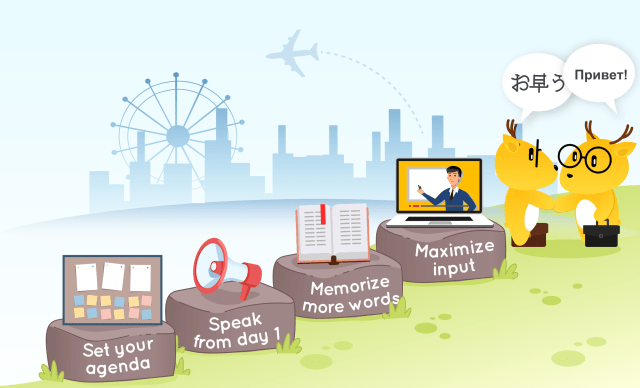

Step 5: Setting Your Agenda
Before you start, be sure that you can make time to commit to a consistent language-learning schedule. If you can carve out two hours a day, then work your schedule to allocate two hours for your new project. If you only have 30 minutes, then focus hard for those 30 minutes and supplement it with fragmented times like waiting for appointments or commuting to work.
And remember, spreading your time out over the week is usually much more effective than bunching it all up into one day per week. This is even true if you can only spare ten minutes per day, for example – a ten minute session each day would be more effective than a one-hour session per week.
If you don’t already have a plan, here are some suggested milestones:
Milestone #1: The Alphabet
- Recommended Time: 1-2 Weeks
- Purpose: To be able to read, write, and speak new words that you come across.
- Goal: Memorize and recall the alphabet as quickly as you can
Whether it’s an app or a book or a podcast, you want to start memorizing the alphabet and some simple vocab that’s common in every language. Make sure to record down what you know and review it with Anki.
Milestone #2: Self-Introduction
- Recommended Time: 2-3 Weeks
- Purpose: To start working with words and phrases using the alphabet
- Goal: To write a short and simple bio about yourself in your target language
Take the time to learn simple grammar and vocabulary with phrases like “I am…”, “I study …”, “My hobby is …”, “I can…”, “I work as…”. Once you can introduce yourself briefly to other people in your target language, you can move on to the next milestone, small talk!
Milestone #3: Small Talk
- Recommended Time: 3-4 weeks
- Purpose: To get comfortable using the language in simple terms
- Goal: Have small talk with a couple of people in your target language
Most of the time, you can have small talk with people online or use apps to help you connect to other people. It might seem scary to initiate small talk, but most native speakers would be surprised you’re learning their language and would gladly help you out with speaking! To reach out for professional help, you can also attend some online language classes.
Milestone #4: Tasks and Missions
- Recommended Time: 4-8 weeks
- Purpose: To be able to use your language to complete daily tasks
- Goal: Buy groceries, deliver items, finding directions to a location, etc.
Remember, you don’t have to go outside and practice this if you can’t. You can practice with yourself by recording audio and playing it back. Or you can recreate these situations by practicing with your tutor or a buddy.
Milestone #5: Expressing yourself
- Recommended Time: 8-12 weeks
- Purpose: To able to elaborate on your points
- Goal: Talk about an issue with some reasoning and examples you have prepared.
You can really start to make your conversations more advanced by adding your own views, retelling events in various tenses and moods and weaving sentences together with connectors. You can start with a generous amount of preparation time and a full script, and then work toward reducing that time to just 5 minutes and using a rough outline. By reaching this milestone, the use of your language is now more sophisticated.
Milestone #6: Improvisation
- Recommended Time: 4-8 weeks
- Purpose: To use the language more freely
- Goal: Talk about a subject you’re familiar with completely off-script.
Everything you’ve learned and all the milestones you’ve accomplished up until this point have led up to this point. It will be hard to improvise from the beginning and that’s okay. You can start by practicing with a script, then move on to mental preparation only, and finally pure improvisation.
Step 6: Speaking From Day One
This is the best way to start learning a language. No grammar rules or book work. Learning a new language requires you to participate in it actively, and there’s no better way to do it than to speak it!
Whether it’s using an app or reading a book, you must speak what you are practicing. Reading the texts out loud will lead to better retention than reading quietly. You can read more about reading out loud and retention based on the University of Waterloo’s study here, as well as here.
Step 7: Memorizing More Words
Imagine what you could do if you remembered literally everything you encountered in your day. You could cram as much as possible into one day and become fluent fin no time. While this unfortunately isn’t possible, there are certain things you can do to make the most of your memory and further enhance your learning speed and capacity. Here are the three we suggest trying:
- Mnemonics
This is a way to encode textual information into weird and wacky images that are much easier to remember. You can read more about a study using them here, a user guide on the artofmemory forum here, and the wiki here. Basically, people who use mnemonics are 88% more likely to recall the things they’ve learned compared to the people who don’t use mnemonics. - Memory palace
A method used by the ancient Greeks to memorize swaths of information for a long period of time. You can read more about it in this blog article, what it is, and how to build one. By using a memory palace, you can store information, in order, and be able to recall it many months in the future. - Spaced Repetition System (SRS)
Written and raved about by many for its learning and memory enhancing abilities. Anki is the best tool for using the SRS and you can read more about it on their website. In essence, an SRS works by having you actively recall information in spaced amounts of time to drastically reduce the time you need to memorize it. You can shorten your time to learning new words from a week to a few days!
Using these three techniques in conjunction with each other makes learning more active instead of passive. Active learning is a tried and tested technique to memorize new information, so go ahead and try these techniques out for yourself!
Step 8: Maximizing Input
Immersing yourself in your language is the best way to gain every other skill than pronunciation. Immersion doesn’t mean going and dropping a couple grand to travel into another country and experience their language.
Here are some quick actions you can take immediately to maximize input:
- Virtual immersion: You don’t have to spend a dime to immerse yourself in another language. You can easily change the language on your phone and laptop to your target language. You can also watch videos with subtitles in your target language.
- Audio immersion: There are some great podcasts out there teaching languages. One of our favorites is the Coffee Break Language series. For beginners, you can just start with listening to songs in your target language. Don’t sweat if you don’t get the lyrics. That’ll come sooner or later.
- Social immersion: Partnering up with a native speaker can help accelerate your learning. They can catch you on your grammar or pronunciation and help you get on the right path. A tutor can be expensive, but it might be worth the investment if you’re willing to become fluent. A cheaper alternative is working with your friend and going along the same study schedule together. You can correct your partner, and they can fix you. Plus, it’s more fun studying with someone else tagging along.
Moving Forward
So now you’re comfortable speaking the language to other people and you’ve gotten the basics down. You can hold a small conversation and make your way around town. What now?
Depending on your goals and where you want to go with this skill, such as using the language for a job interview or academic purposes, you want to start accumulating more advanced vocabulary or phrases and produce more sophisticated expressions. Oh, and you’ll want to make sure you’re maintaining a daily practice routine. It’s crucial that you keep up the consistency – otherwise you risk forgetting parts of the language over time!
Some of the practices we recommend:
- Read in-depth articles or watch documentaries in your target language that relate to the industry that you’re in. This would give you a new breadth of vocabulary that you normally don’t use in a day to day conversation.
- Try preparing for a language test. Even if you don’t need the certificate for anything specific, it’s still a great thing to do. The exercises and mock tests will further push you to hone specific skills, and it will also give you a strong sense of accomplishment and closure for the effort you’ve made so far.
- Write more. Give yourself a writing assignment every other day and try to make use of the new words and phrases you learned through reading. Send your drafts to a native friend or a tutor to get feedback.
Hitting A Plateau?
Most intermediate learners find themselves stagnating after reaching B1 or B2. A lot of the resources available are too slow or easy for upper-intermediate learners. They’re completely left on their own to figure out a path to near-native proficiency.
This is what we call the plateau of language learning. There’s no one-size-fits-all solution for everyone. Every upper-intermediate learner needs to do a thorough audit of their skills and design their own improvement strategies.
A good way to break out of this plateau is to find yourself a project. For example, while interpreting may seem like something only professionals do, you can still try shadowing or interpreting to practice your oral skills. Also, combine the project with your hobbies, such as translating your favorite shows or video blogging in your target language.
What Do You Do With A Second Language?
Even reaching intermediate in a new language starts to generate interest in terms of career development. Bilinguals or polyglots mainly have two tracks to consider: linguistic track and non-linguistic track.
The linguistic track includes all professions that use language skills for most of the job responsibilities, such as translation, interpretation, teaching or research. The options aren’t as diverse, and they are best suited for those who are truly obsessed with languages.
The non-linguistic track has a lot more options: essentially, you are to distinguish yourself by combining your language skill with another professional skill. For example, if you’re bilingual or trilingual wine expert, you have an edge over the monolingual sommeliers, for you can use your second language to serve a new clientele or negotiate with the suppliers.
The modern workplace is constantly reinventing itself and updating its labor demand. The world we’re in calls for M-shaped individuals (as opposed to T-shaped individuals) who specialize in two or more areas and continue to pick up more skills along their careers.
To any employer with a sharp eye for talent, your ability to speak another language and the ability to teach yourself a new skill translate to these highly desirable qualities: high intelligence, a respectable level of self-discipline and connections to a new demographic that was previously unknown to them.